Did you know that many professional traders believe psychology matters more than strategy over the long run? You can have the best setup in the world, but if you can’t manage your emotions, execute consistently, or accept losses, you’ll struggle to stay profitable.
I’ve read quite a few books on trading psychology, and while Trading in the Zone is often considered the gold standard, I actually found a few others that had an even bigger impact on how I think about trading. Rather than simply telling you how to think, these books show you what successful traders experienced, how they dealt with setbacks, and why managing risk is ultimately what separates professionals from everyone else.
Why Trading Psychology Is More Important Than Strategy
There are millions of traders, investors, money managers, and others taking part in the world’s financial markets. Nowadays, a lot of the heavy lifiting is done by machines: algorithms pulling the strings, moving whenever certain conditions are met.
However, behind those machines are still human beings, who aren’t perfect. The machines become more efficient in time, but aren’t perfect either. When you’re dealing with money it’s very plausible emotions take over because you want more of it, you don’t want to lose any of it, and because you might overestimate your capibilities.
A lot of traders have proven that, in order to stay in the game, you can’t just rely on luck, because luck isn’t a consistent strategy. It’s about stacking the odds in your favour and staying in the game. The better you are at this, the higher the chances you’ll take part in the game.
These ideas have been written down for the ages, for future traders and investors to read and understand, in order to apply them to their own trading and investing. Let’s take a look at some of the best books written on the subject and see what they can provide you in your journey towards a mental edge.
Best Trading Psychology Books
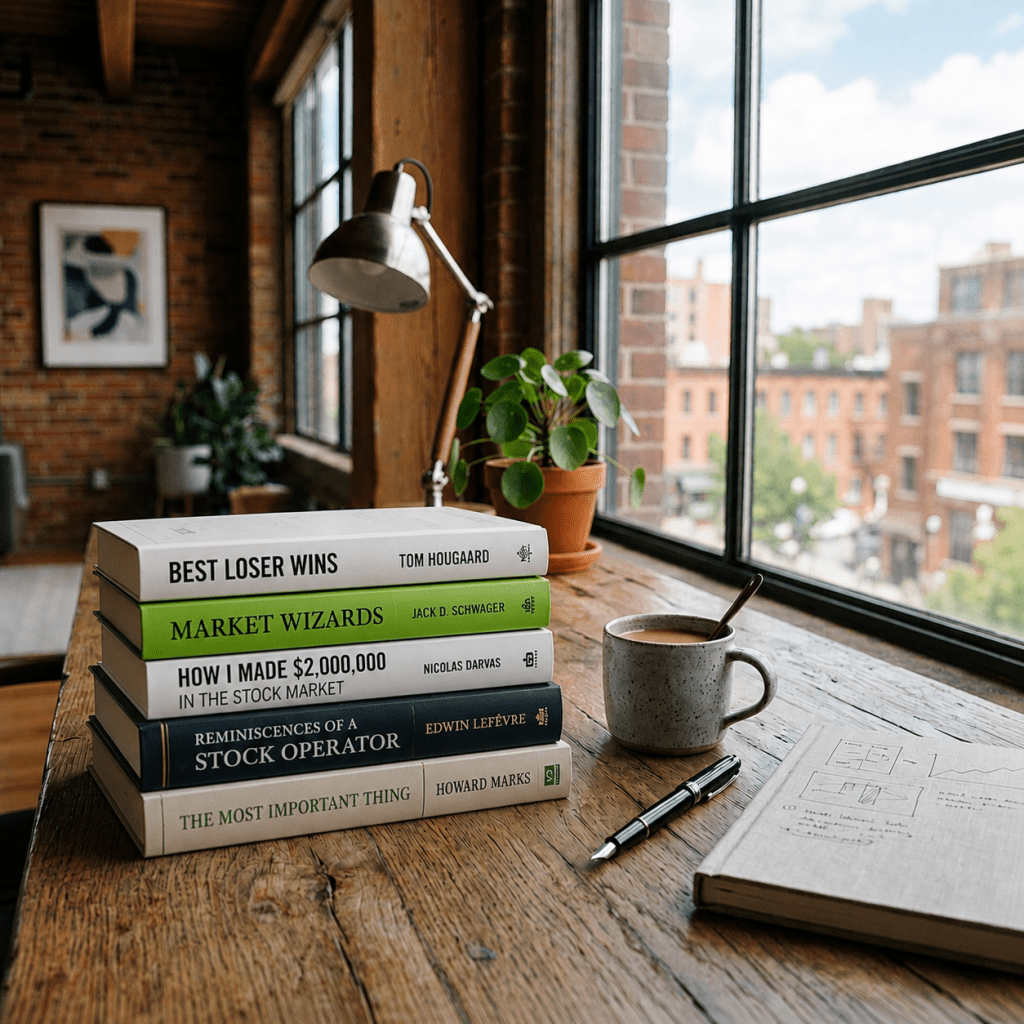
1. Best Loser Wins — Tom Hougaard
Why I recommend it:
This is probably the most practical trading psychology book I’ve read.
Hougaard changes the way you think about losing. Instead of trying to avoid losses, he explains why the best traders actually become comfortable taking them quickly. The goal isn’t to win every trade—it’s to lose less when you’re wrong and maximize your winners when you’re right.
Key lessons
- Professional traders think differently about losing.
- Accept losses quickly.
- Stop letting ego influence decisions.
- Focus on execution instead of being right.
2. Learn From Traders Who’ve Actually Been There
- Market Wizards — Jack D. Schwager
- How I Made $2,000,000 in the Stock Market — Nicolas Darvas
- Reminiscences of a Stock Operator — Edwin Lefèvre
Why I grouped these together:
These books aren’t traditional psychology books, yet they taught me more about trading psychology than many books dedicated to the subject.
One thing quickly becomes obvious: every successful trader struggles.
They all experience drawdowns, self-doubt, mistakes, and emotional decisions. That’s reassuring because it’s easy to believe you’re the only one going through those challenges.
These books reinforce that trading is a process, not a destination.
Key lessons
- Every great trader loses.
- Emotional control develops through experience.
- Patience often beats activity.
- You have to put in the work.
- There isn’t one “perfect” trading style, you have to find your own edge.
3. The Most Important Thing — Howard Marks
Why I recommend it:
Although this isn’t strictly a trading psychology book, it changed the way I think about risk.
Howard Marks constantly reminds readers that investing and trading aren’t about maximizing returns—they’re about managing risk.
His honest observations and reverse psychology approach force you to question common assumptions and think in probabilities instead of emotions.
Key lessons
- Risk comes first.
- Think in probabilities.
- Avoid overconfidence.
- Long-term success comes from avoiding major mistakes.
Honorable Mention: Trading in the Zone by Mark Douglas
This is the classic recommendation whenever someone asks about trading psychology—and for good reason.
Mark Douglas provides a practical framework for developing consistency, eliminating fear, and trusting your trading system.
That said, I personally found the books above offered a more personal perspective. Reading about real traders, their mistakes, and their thought processes helped me develop a healthier mindset than relying on theory alone.
If you’re new to trading psychology, Trading in the Zone is still absolutely worth reading. I just wouldn’t stop there.
Which Trading Psychology Book Should You Read First?
If I had to recommend an order:
- Best Loser Wins — for practical mindset shifts.
- Market Wizards — to learn from elite traders and understand you have to put in the work.
- Reminiscences of a Stock Operator — timeless lessons that still apply today.
- How I Made $2,000,000 in the Stock Market — a fascinating real-life trading journey.
- The Most Important Thing — to master risk management.
- Trading in the Zone — to reinforce psychological principles.
Conclusion
No single book will instantly make you a better trader. Trading psychology develops through experience, reflection, and countless hours in the market.
For me, the biggest lesson wasn’t learning how to win more—it was learning how to lose better, manage risk intelligently, and understand that even the world’s greatest traders struggle.
If you can combine the practical mindset from Best Loser Wins, the real-world experiences from Market Wizards, How I Made $2,000,000 in the Stock Market, and Reminiscences of a Stock Operator, and the risk-focused thinking of The Most Important Thing, you’ll build a much stronger trading mindset than by relying on a single psychology book alone.
Let me know which trading psychology book is your favourite!


Leave a comment