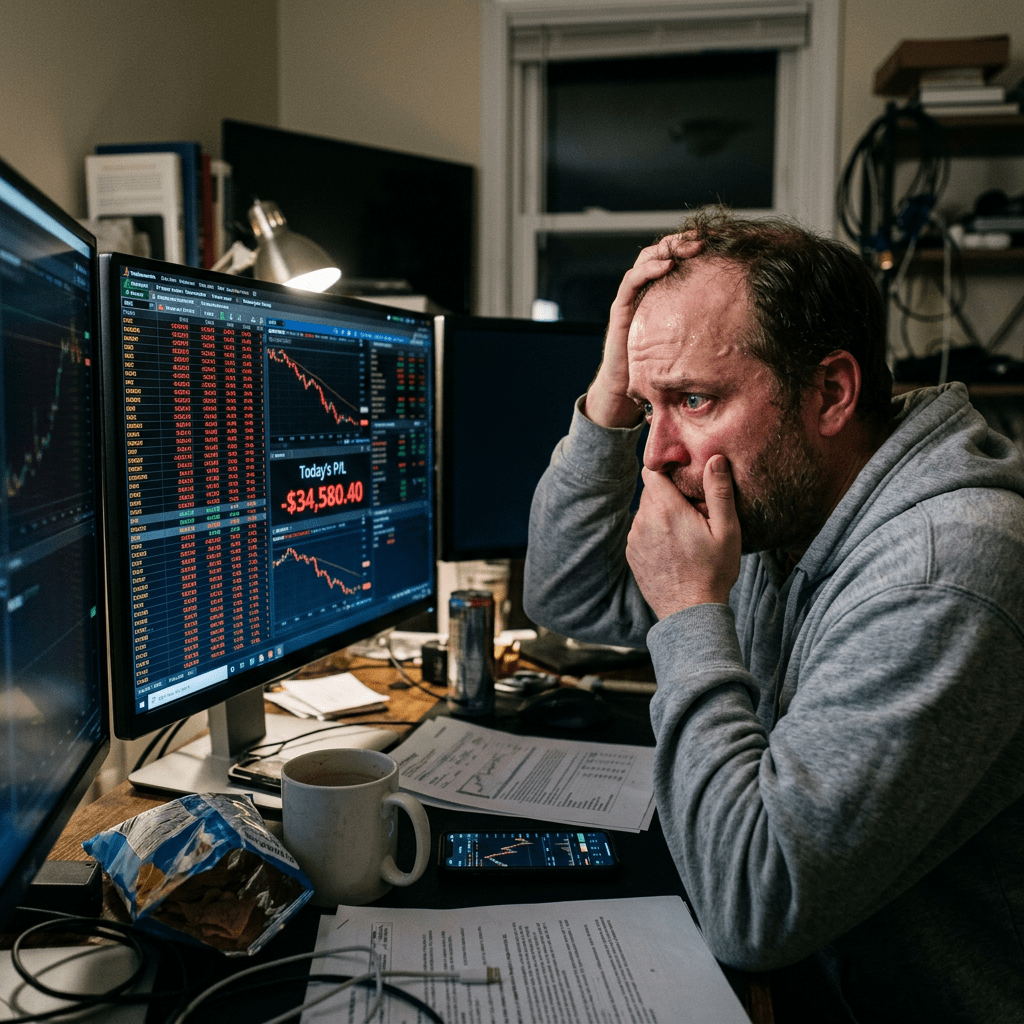
I’ll say it plainly: overtrading has probably cost more traders their accounts than bad stock picks ever will. It’s often said that most retail traders don’t blow up because they picked the wrong ticker — they blow up because they clicked “buy” too many times. Sound harsh? Maybe. But it’s true. If you’ve ever caught yourself opening a new position minutes after closing a losing one, or refreshing your trading app for the fifth time before lunch, you already know the itch. That itch has a name. Overtrading is a quiet account-killer that turns a perfectly good strategy into a slow bleed of commissions, slippage, and stress. It doesn’t announce itself with a dramatic crash. It shows up in small decisions, made too often, for the wrong reasons. This post walks through what overtrading looks like, why your brain talks you into it, and — most importantly — how to stop overtrading before it stops your trading career. Whether you’re a day trader chasing every green candle or a swing trader who can’t sit on your hands, the signs are more recognizable than you’d think. Let’s get into it.
What Is Overtrading? (And Why It’s So Easy to Miss)
Overtrading happens when a trader executes more trades, larger positions, or higher-risk trades than their strategy, account size, or actual market edge can support. It’s not about a specific number of trades per day — a scalper might make forty trades and be perfectly disciplined, while a swing trader making four undisciplined trades a week is overtrading just as badly. The distinguishing factor isn’t volume; it’s whether each trade is backed by a real signal, a defined risk plan, and genuine conviction, or whether it’s driven by impulse, boredom, or the need to “do something.” This is exactly why overtrading is so easy to miss in the moment. It rarely feels reckless while it’s happening — it feels like diligence, like staying sharp, like not wanting to miss out. The damage only becomes obvious in hindsight, when the P&L and the commission statement tell a very different story than the one you told yourself in the moment.
The Psychology Behind Overtrading
Overtrading isn’t a knowledge problem — most overtraders can recite risk management rules perfectly. It’s an emotional and neurological one. Every trade, win or lose, triggers a small dopamine response and the brain quickly learns to chase that hit rather than wait patiently for genuine setups. FOMO fuels this cycle: watching a stock run without you feels almost physically uncomfortable, so you jump in late, often at the worst possible price. Revenge trading follows the opposite path — a loss stings, and instead of sitting with that discomfort, you fire off another trade to “win it back” immediately. Boredom during choppy or slow markets pushes traders to manufacture action where none is warranted, and a hot streak can flip the switch to overconfidence, convincing you that your instincts alone are enough to skip the rules. Layer on top of this the design of most trading apps — real-time price ticks, push notifications, gamified interfaces — and you have an environment practically engineered to keep you clicking.
Signs You’re Overtrading
- You’re trading outside your plan or strategy rules
- You increase position size after a loss to “make it back” faster
- You feel anxious or restless when you’re not in a trade
- You’re trading multiple uncorrelated setups just to stay busy
- Your win rate is stable but your account balance keeps shrinking
- You check your portfolio or open trades more than 20 times a day
- You’re trading during hours or conditions you know you should avoid
- You can’t clearly justify your last three trades if asked
- Your risk-per-trade has crept up without a deliberate decision to change it
Overtrading tends to show up as a cluster of small habits rather than one obvious red flag, which is why a checklist approach works well here. The first and clearest sign is trading outside your own plan — taking setups you wouldn’t have flagged if you were reviewing someone else’s trade. Increasing position size after a loss, often called “doubling down,” is one of the fastest ways to compound a bad day into a disastrous one. Many overtraders also describe a restless, anxious feeling when they’re flat (not in any position), as if being out of the market means missing something important. Jumping between unrelated setups — a biotech breakout, a forex pair, a crypto pump— just to keep the action going is another telltale pattern, since it usually reflects a need for stimulation rather than a genuine strategy. One of the more insidious signs is a stable or even decent win rate paired with a steadily shrinking account, which points to costs (commissions, spreads, slippage) from sheer frequency eating into gains. Compulsively checking positions dozens of times a day, trading during sessions or conditions you’ve previously identified as unfavorable, being unable to clearly explain your last few trades, and letting risk-per-trade quietly increase over time round out the pattern. If two or three of these sound familiar, it’s worth taking a hard look at your trading log or journal!
The Real Cost of Overtrading
The cost of overtrading is rarely a single catastrophic loss — it’s death by a thousand cuts. Commissions that look negligible on one trade become a significant drag when multiplied across dozens of unnecessary trades every week. Slippage compounds this further, since impulsive, fast-fingered entries and exits routinely get filled at worse prices than planned trades taken calmly. In many countries, frequent short-term trading also triggers less favorable tax treatment compared to longer-term holding periods, quietly reducing net returns even further. Beyond the financial toll, overtrading takes a real toll on mental health — constant monitoring disrupts sleep, elevates stress hormones, and can bleed into relationships and work performance. There’s also a hidden opportunity cost: capital tied up in low-conviction trades isn’t available for the genuinely high-quality setups that come along less frequently but matter far more to long-term performance.
How to Stop Overtrading: Practical Strategies
Stopping overtrading starts with structure, not willpower — relying on discipline alone rarely works once emotions are running high. A hard trade limit (for example, no more than three trades a day) creates a built-in circuit breaker, forcing you to be selective rather than reactive. A pre-trade checklist is one of the most effective tools available: if a setup doesn’t check every box — trend confirmation, risk-reward ratio, position sizing rules — it doesn’t get taken, no exceptions. Building in a mandatory cooling-off period after any loss, even just 15-30 minutes away from the screen, interrupts the revenge-trading impulse before it turns into action. Cutting down on screen time and disabling non-essential price alerts reduces the number of moments where temptation even has a chance to strike. A detailed trading journal — logging not just entries and exits but the actual reasoning behind each trade — creates accountability and makes patterns of overtrading impossible to ignore. Finally, a firm daily loss limit that shuts down trading for the day once triggered protects both your capital and your emotional state from a downward spiral.
When Overtrading Becomes a Bigger Problem
For most traders, overtrading is a fixable behavioral pattern — but for some, it can shade into something that looks more like compulsive gambling than trading. If you find yourself trading despite repeated promises to stop, hiding your trading activity or losses from family, or chasing losses well past the point of rational strategy, it may be worth speaking with a financial therapist or counselor who specializes in behavioral finance. This isn’t a sign of weakness or a reason for shame; the mechanisms that drive overtrading are the same reward pathways involved in other compulsive behaviors, and they respond well to the right kind of support. Recognizing that a pattern has become bigger than “just a bad trading habit” is, in itself, the hardest and most valuable step toward actually fixing it.
Conclusion
Overtrading rarely announces itself. It creeps in one impulsive trade at a time, dressed up as diligence, opportunity, or just “staying active.” But here’s the good news: it’s also one of the most fixable problems in trading. Unlike a flawed strategy or a bad market read, overtrading responds directly to structure — hard trade limits, a real trading plan, a detailed journal, and a little distance from the screen.
Start small. Pick one sign from this list that hit closest to home, and build a single rule around it this week. Maybe that’s a three-trade daily cap. Maybe it’s a mandatory 20-minute break after any loss. Whatever you choose, track it. Because at the end of the day, the traders who last aren’t the ones who trade the most — they’re the ones who know exactly when not to.


Leave a comment